n8n 3.0 upgrade is one way: no going back to 2.x
n8n says the upgrade to 3.0 is one way, with no going back to 2.x. Why a rollback is off the table, who it affects, and what to do before you upgrade.
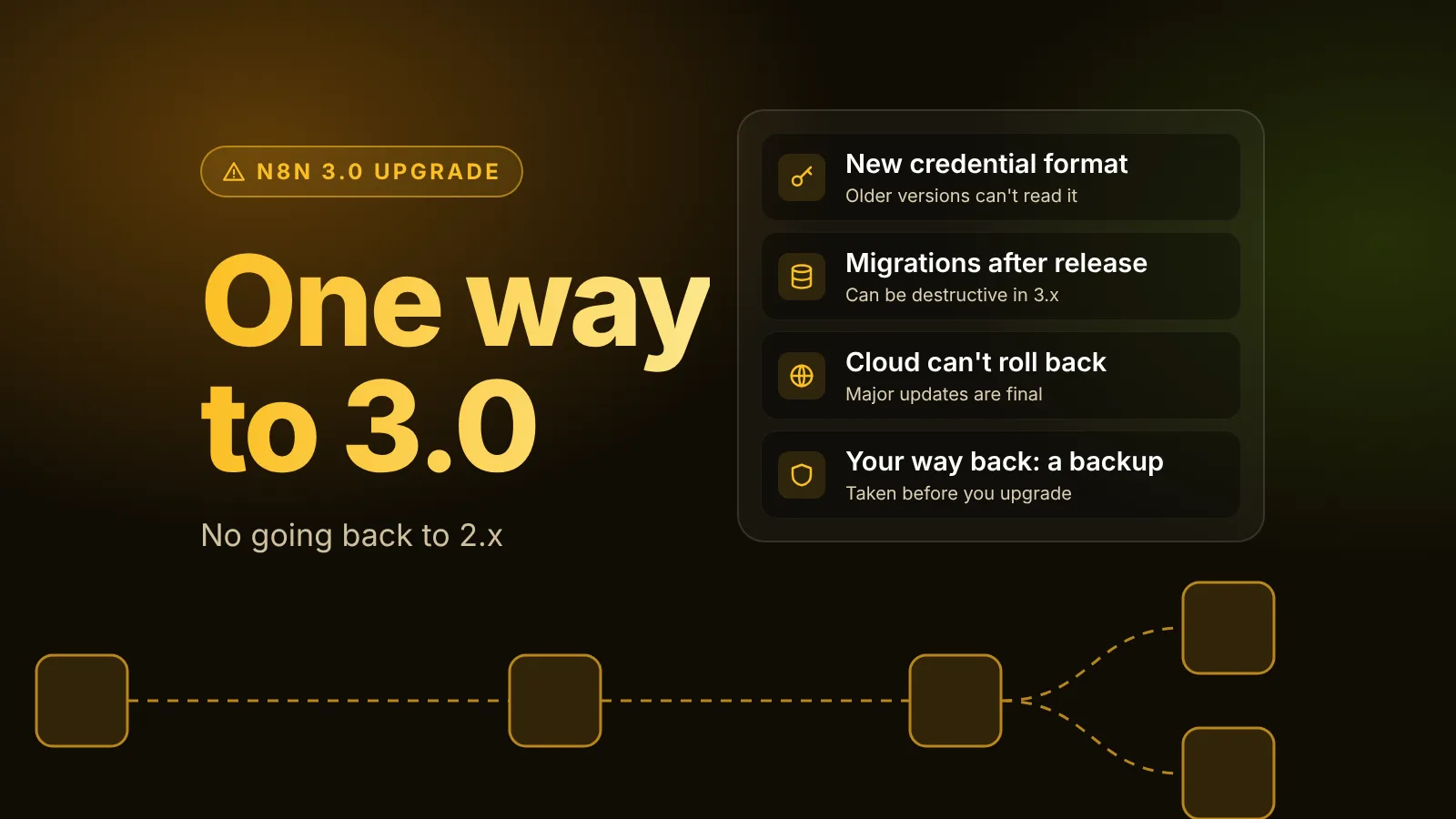
Upgrading to n8n 3.0 is a one-way move. In its 3.0 announcement, n8n says that once you move to 3.x, "there's no going back to 2.x afterwards." If 3.0 breaks something, you can't just switch your Docker image back to 2.x; the only way back is a backup taken before the upgrade.
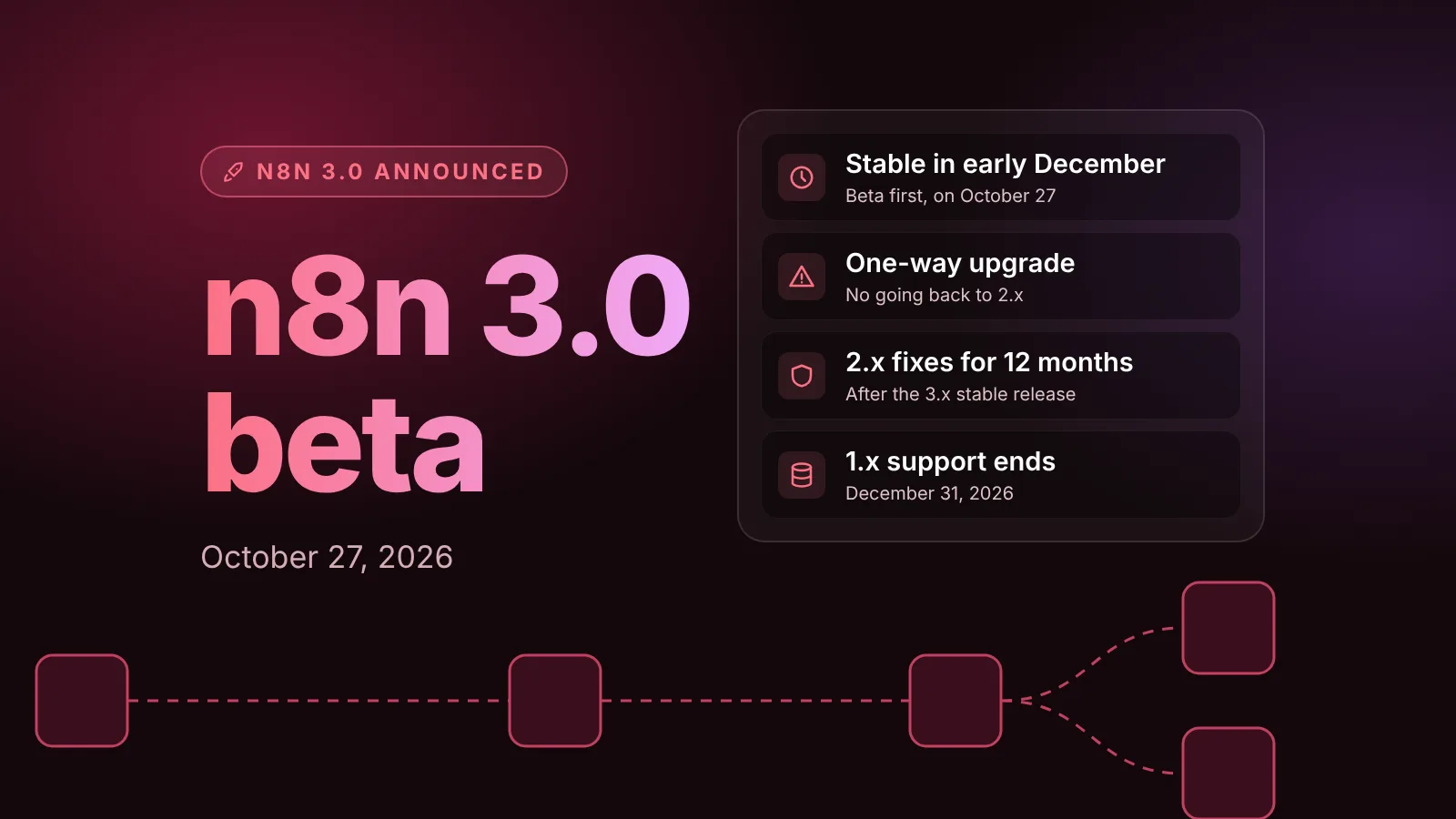
That matters now because the 3.0.0 beta arrives on October 27, 2026, with stable 3.x following in early December. Here is why n8n can't promise a rollback, who it affects, and what to do before you upgrade.
The short version
- No downgrade. n8n doesn't support running 2.x again on data that 3.x has upgraded.
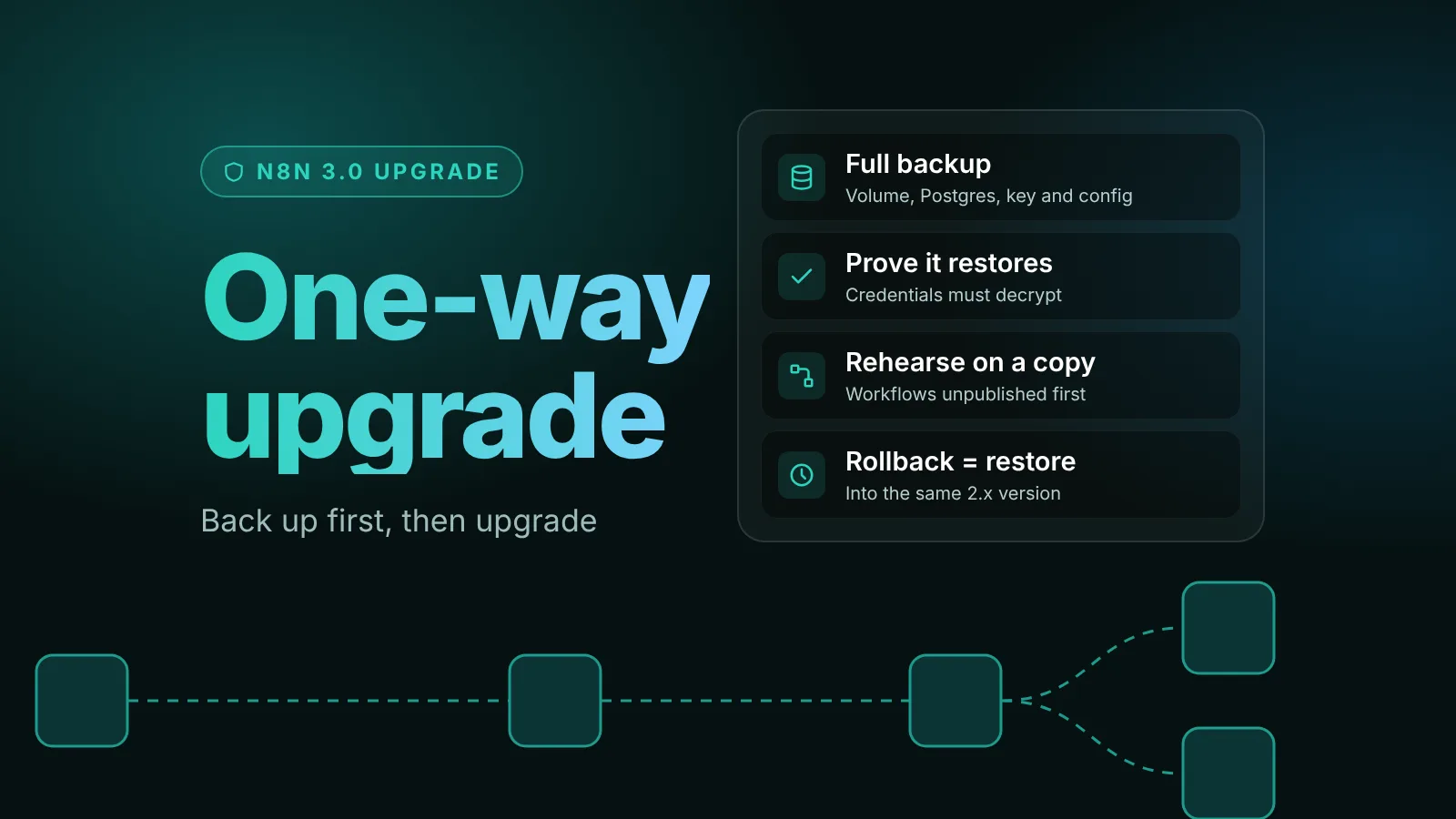
- Your rollback is a backup. Take a full backup before the upgrade, and restore it into the 2.x version you ran before if you need to go back.
- Credentials change format. 3.0 turns on encryption key rotation by default, and n8n's docs say older versions can't read credentials written in the new format.
- Cloud too. On n8n Cloud, major-version updates "can't roll back," per n8n's docs.
- No rush. 2.x gets security and critical bug fixes for 12 months after the 3.x stable release, so you can wait until you've tested.
What n8n announced
The announcement, posted on n8n's community forum on October 23, sets the dates for 3.0 (our post on the announcement covers them) and is direct about the upgrade path: moving to 3.x is one way. n8n recommends testing 3.0 on a non-production instance first and taking a full backup before you upgrade.
The announcement doesn't list every technical reason. n8n's docs and development guide show three.
Why you can't roll back to 2.x
Credentials are written in a new format
n8n 3.0 turns on encryption key rotation by default. With it on, n8n encrypts credentials "in a new format that includes a key identifier," and the docs warn: "Older versions of n8n can't read this format."
There is no way to convert that data back. Per the same page, "There's no automated tool to convert data encrypted in the new format back to the legacy format," and if you end up on a version that can't read it, "the only recovery path is restoring from a database backup."
Existing credentials aren't converted all at once. n8n re-encrypts each record in the new format the next time it's updated, and new credentials use the new format from the start. So the longer a 3.0 instance runs, the more of your data depends on 3.x.
Database migrations can be destructive after the release
n8n's internal v3 development guide tells its engineers to write non-destructive database migrations for now, and adds: "After the release of v3, you can create the destructive part of migration if needed." In plain terms, 3.x releases are allowed to remove or reshape database tables and columns that 2.x still needs.
That's a permission, not an announced change. But it's the reason a 2.x rollback that happens to work on one 3.x version can stop working on the next.
n8n Cloud can't roll back major updates
On n8n Cloud, you opt in to 3.0 by choosing 3.0.0 Beta (early access) when you change your n8n version. n8n's Cloud update docs say that if the new version "is a major version or runs a database migration, n8n asks you to confirm," and "You can't roll back these updates to the previous version." Treat the beta opt-in as permanent for that workspace.
What we saw in our test
On October 24 we ran a 2.44.6 instance on Docker, created a credential, then upgraded the same data to the 3.0 release candidate v3-rc-20261019.1 and created a second credential. The database showed the difference: the 2.x credential was still stored in the legacy format, while the one created on 3.0 started with a key identifier, the new format from n8n's docs.
We then pointed 2.44.6 back at that data. It started, and it decrypted both credentials, including the one written in the new format. Recent 2.x versions already include key rotation as an opt-in feature (N8N_ENV_FEAT_ENCRYPTION_KEY_ROTATION), which likely explains why. Our October 18 nightly test also rolled back to 2.x without errors.
Don't read that as a rollback plan:
- It was a preview build, not the beta or the stable release, and a later 3.x version can add migrations that 2.x can't handle.
- We tested one 2.x version, 2.44.6. n8n's docs say older versions can't read the new format.
- n8n says there's no going back, so a 2.x instance running on 3.x data is unsupported, and any problem is yours to fix.
Who this affects
| Setup | What one way means for you |
|---|---|
| Self-hosted with Docker | Changing the image tag back to 2.x isn't a supported rollback. Restore the backup you took before the upgrade, and run the same 2.x version you backed up. |
| Kubernetes or Helm | The same rule applies to your pods and database: keep a database backup taken before the upgrade. |
npm or npx | 3.0 isn't published as a runnable npm package, per n8n's breaking changes page. Move to Docker on your current 2.x version first, then upgrade. |
| n8n Cloud | Major-version updates can't be rolled back. Try the beta on a workspace you can afford to keep on 3.x. |
| Still on 1.x | There is no direct path from 1.x to 3.x. Upgrade to 2.x first; 1.x support ends on December 31, 2026. |
What to do before you upgrade
- Stay on a pinned 2.x version in production for now. The current stable release is 2.44.6, and 2.x keeps getting fixes for 12 months after the 3.x stable release.
- Work through Settings > Migration Report (available from n8n 2.39) and fix what it flags. Our n8n 3.0 breaking changes guide covers each change.
- Take a full backup of the database, the n8n data volume, your
N8N_ENCRYPTION_KEYand your configuration, and check that it restores. - Upgrade a copy first, then production.
If you want the detailed steps, with the exact commands we ran to back up, test a restore, rehearse the upgrade and roll back, read our guide: Upgrading to n8n 3.0 is one way: back up and upgrade safely.
Sources
Editorial team
The then8nblog editorial team researches every article from n8n's release notes, documentation and source code, states the n8n version each guide was tested on, and has every post reviewed by a human editor before it goes live.